Send me some feedback either via the comments or via email: what do you find to be the most useful content when it comes to motorcycle stuff? Or, what stuff do you most like to do/read/enjoy when it comes to looking stuff up about motorcycles online?
1) How to do mods and maintenance on bikes
2) Product and bike reviews
3) Riding tips and tricks (e.g. DMV tests, class reviews, moves to try)
4) Forums to talk to other bikers, exchange ideas, and talk shop
5) A place to share your own riding experiences, like a blog or travel log site
6) Rider basics - learning to ride, finding your first bike, getting your basic gear
7) Other - what?
Tuesday, June 24, 2014
What do you find most useful?

Monday, October 25, 2010
Sturgis Pictures
Here are some pictures from my trip to Sturgis with my husband. They have been keeping me going as we approach fall and the close of riding season...
 The trip up was a little bit eerie to someone who comes from a place where you can't gaze in any given direction without seeing a building. The windmills against the backdrop of so much empty space looked kind of alien.
 We kept passing all of the crazy signs from Wall Drug. Sadly we did not visit but they were fun to look at. Also, a dinosaur.
 This is me on Day 1 of our stay - we went to Mount Rushmore. Clearly I am windblown.
 This is the view looking across the mountains from the Rushmore parking lot. I know for people who live around there it must be easy to forget but to me, the views are all breathtaking and gorgeous!
 This is the entry plaza leading up to Mount Rushmore.
 After entering, this is what you see - a walkway leading up to the sculptures themselves.
 My one focused shot of the most photographed and replicated structure on Earth.
 If you look at all of the pillars in the plaza before the structure, each one is labeled with a state and has a flag flying above it, giving all of the above information.
 The same day, we went to Crazy Horse. Talk about inspiring. My favorite quote from the sculptor: "When the legends die, the dreams end. And when the dreams end, there is no more greatness." -Korczak Ziolkowski
 Here is what Crazy Horse is supposed to look like when it is completed. This was very inspiring.
 On Day 2: Sturgis itself! The vendors were all closing down and there was not a glut of bikes as I imagine there usually is, but it was cool to walk around, pick up some bargains post-rally, and window shop.
 A cool mural.
 Not a good shot but as you can see, Sturgis clearly thinks it is the Hollywood of motorcycles.
 This is where we had a nummy burger for lunch.
 And saw some spiffy memorabilia.
  Our third and final day... Custer National Park.
 Can you see the buffalo? Yeah I thought it was small too. Then it stood up and we rode away as fast as we could. I was afraid it would take the sound of our pipes as a sign of aggression... fortunately it just rolled around in the dirt a bit and went back to sleep.
And then I got stuck in a crevice.
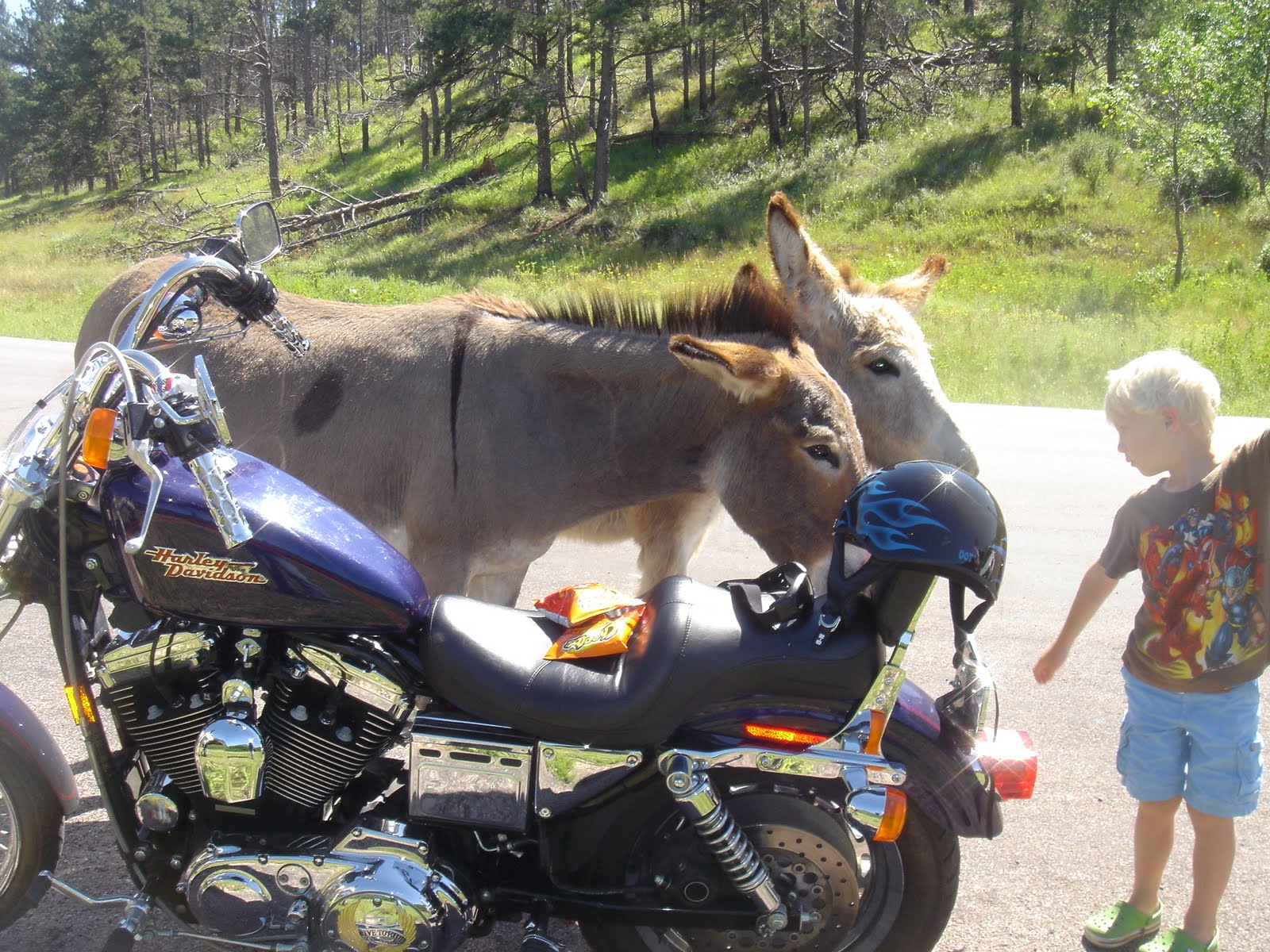 Which would you rather ride? Bike? Wild burrow? They were a riot, they will eat anything. I really hope the Cheetos we gave them did not cause any bad side effects...
 Yes, the buffalo really were that close to the road and yes, that really did make me very nervous.
Um... buffalo crossing. Just FYI... I don't endorse getting this close to buffalo. Everyone we spoke to really liked telling us horror stories about how a friend of a friend got gored by one. So Yeah. Be careful.
Of everything we did, though, I think Custer National Park was my favorite, with Crazy Horse being a close second. All-in-all, a good trip!
Thursday, August 12, 2010
Sturgis!
I hope everyone is having a great time at the rally this week!
My husband and I are actually headed to Sturgis on Saturday. We'll be there the week after the rally just riding around and seeing the sights - we figured it's best to miss the crowds since it's my first time.
I am very excited and will post any cool pictures from our trip here throughout the week!
Wednesday, July 28, 2010
How to Wash and Detail a Motorcycle

Wow - what a week! It's definitely been a tough one for me, and I've had a great deal on my mind lately between work and school starting again. My usual escape is retreating into a book, internet surfing, or just curling up and getting some much-needed sleep, but this past weekend I decided to clean and detail my motorcycle.
Detailing your motorcycle is actually an excellent way to bond with your bike. First of all, the process is almost meditative. Taking a systematic approach and paying careful attention to what you are doing is not only beneficial for your bike - preserving all of that shiny paint and chrome - but it can also be extremely relaxing, giving you a chance to either get your mind off of whatever is bothering you, or else take out your frustration on any particularly stubborn bug stains (my windshield has a bug magnet on it, seriously).
The products pictured are ones I purchased at my local motorcycle shop; I don't necessarily endorse them, though if I experienced a problem using a product, I will note it. If you have a particular favorite, please share with the rest of us in the comments!
As a general note, I'd like to make one suggestion before you get started: either set aside a couple of hours for the task, or else break it up into a multi-segment project. As long as you do not leave any product residue on your bike, you are safe breaking the process up across a few different sessions or even days, just depending on your availability and energy. The reason I mention this is because somehow, I always pick the hottest, most humid day of the year to detail my bike, and half-way through I end up exhausted and wishing I could wait until later to finish up. Sadly my schedule doesn't really allow for it, but if yours does, it might be worth it.
Step 1: General wash and rinse

Your first step is to wash your motorcycle get all of the grit and grime off of your bike that could cause scuffs and scratches if not removed before you start waxing. You can find any good spray-on, rinse-off wash at your local motorcycle or auto supply shop; the one pictured actually worked extremely well and was an all-purpose cleaner, so it was safe for all of the bike's surfaces.
I would also like to note that now is the time to
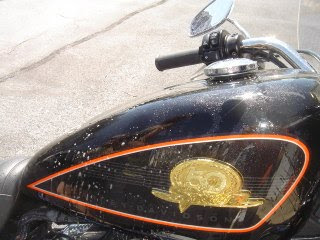
decide how you are going to approach your motorcycle washing and detailing job: front to back? Back to front? Kick-stand side or pipes side first? Pick one and stick to it; it will make your life easier later when we get to waxing.
General cleaners like this one are meant to be sprayed on and then rinsed off with a hose. I sadly don't have access to a spout, so I just use a bucket. Graceful, I know. Be VERY careful at this stage if you use a rag and water to rinse the cleanser off of your bike: first of all, make sure you get it all off, otherwise it may cause permanent clouding if left to sit. Second of all, debris caught in a rag will scratch your paint job and your chrome if it's not rinsed out right away. Don't worry if there is a bit of streaking at this stage after you've rinsed the cleanser off, though - you will be going back over the motorcycle with a detailing cleaner-wax later, so you can fix that as you go.
Also remember on a hot day that you should be very careful that the cleanser does not dry on your motorcycle as you move from segment to segment - spray on and rinse off fairly quickly toprevent this.
Step 2: Get thee in the shade!
Don't do the remaining steps in direct sunlight and heat. Move the motorcycle you are cleaning into a shady area or your garage. Leaving wax products on your motorcycle and allowing them to dry in the heat and sunlight can cause damage to your chrome and paint in the long-term - the exact result we're looking to avoid in this process! Plus... it's just a lot cooler in the shade, and who can argue with that? Heat stroke and motorcycle detailing do not go together.
Step 3: Wax-On, Wax-Off

After getting the bugs, dust, and other grit off of your bike, it's time for the detailed work. Youwill want to select a good detail/wax product. Here is the one I used. This product is actually a good, standard, decently-priced wax, and I found that it wiped off fairly easily after application, not leaving an overly-streaky residue like I have run into with other products.
I keep a big pile of clean cloths on-hand for this process. First I spray the wax onto the cloth, then apply to the bike. I let it sit for a little bit - not more than a minute at most - then wipe it off with a separate cloth.
I use a lot of cloths throughout this process but

there are those who don't; I just really like to polish for a high shine. Again, the product pictured was good for use on the chrome and the paintjob. The reason I prefer to apply it with a cloth is because you don't want to get this stuff on your brakes - be very careful, otherwise
you create a dangerous situation for the next time you are out on the road. Also most of these products are not good for use on leather - check the label of the one you pick and make sure you take off any pieces not recommended for use with that product.

Using circular motions to apply and remove wax isn't just for the karate kid, by the way. You'll find it to be the best way to keep from leaving an icky residue when you are wiping the wax off.
 Step 4: Corrosion Protectant
Following your washing and detailing, you will want to do a little something-something for your chrome to prevent long-term pitting or rusting. I recommend getting a good corrosion protectant. The one pictured was OK, but I found it very difficult to wipe off after applied - it left some streaking and was really oily. If anyone has any better luck with another product or any other suggestions for protecting your chrome, please leave some info for us in the comments.
 Step 5: Scratch Removal
The next step in our process is to use that elbow grease you've saved up (yeah, right) to try and buff out any scratches you might have on your paint job. Keep in mind the scratch removal polish you can get at the shop will do a pretty good job on smaller stuff, but a fairly deep or large scratch will need buffing. We'll go over that at another time - a professional grade buffer can be a good investment in the right hands; in the wrong hands, it can really damage your fancy paint job. I don't really have any particularly noticeable scratches on my bike at the moment (it's been in the garage for far too long), but use the same circular motion on your scratches that you did for the detail and waxing. The trick for this? Just keep going - your dominant arm should end up pretty sore by the end of this process anyways. If it's just not coming out, again, you should consult a professional about getting it buffed out without damaging your paint job.
Step 6: Finishing Touches
Other options are available for getting your bike into pristine condition. Some people swear by tire blackeners (possibly not a good idea if you are zipping around on two wheels, though - for the same reason you shouldn't get wax on your brakes or tires), other people like to spend hours polishing each individual spoke. Some people viciously attack errant bug splatters on their windshields with Windex or other cleaning products. Let us know what else you like to do to make your bike perfect for riding season!

Monday, July 19, 2010
This Weekend: Detailing
This Sunday afternoon, weather permitting, I shall be detailing my pretty little Sportster as part of getting her back on her proverbial feet (tires?). I'll post the details when I'm finished - it's actually quite an involved process for those wishing to do it the right way, and with their own two hands. Really, detailing your motorcycle is an extremely relaxing exercise; it's almost meditative, and it's a wonderful way to bond with your ride.
Hope the weekdays are short and the weekends are long and you get to ride a million miles in between! Ride safe.
Sunday, July 18, 2010
Back to Basics
Well, it's been a few years.
My Sportster has sat in her garage gathering dust, I'm sorry to say.
To explain... I started law school in the fall of 2008 and everything else has taken a back seat since then. I have gone on my occasional joy ride when I haven't been too busy, but sadly I just have not had the time to dedicate to riding or motorcycles that I would like.
This saddens me in a lot of ways, as I always feel such a sense of empowerment and adventure and positivity when I ride. I've replaced that with a lot of negative things in my life. Work. Stress. I've handed my life over to people and things that could care less about adventure and exploration and instead focus on the bottom line and seeing exactly how much blood they can draw from you until you finally cry out that it's enough.
That's not to say I don't understand. Progress and hard work and stress make the world go round. Not all stress is bad. But, there comes a point at which it gets to be soul-crushing. There comes a point where you need to break free from the people trying to control you and to take control of yourself and your life again. And that means that the very things that drew me away from riding are now driving me back to it full-force.
I know at this point the hard work I put into this blog a few years ago is mostly moot; I hope some of the information at least has been helpful, lying out here in the ether, collecting cyber-dust. I'm hoping it can be helpful again.
In a few weeks, my husband and I are going to Sturgis - after the rally, to avoid the crowds. In the interim, in order to save my own sanity and to reconnect with riding and prepare myself for the trip, I think I'm going to start writing here again. This blog might become a little more personal in many ways, but I'd still like to provide useful information for anyone who needs it. My husband and I are brainstorming a series of articles to start out with. So here's hoping!
Saturday, May 3, 2008
Grayslake Officials Cancel Bike Show Event Due To Public Safety Concerns
The following press release was issued by the Village of Grayslake in Illinois on Friday evening regarding an event held by Austin's Saloon that was to receive an anticipated 40,000 attendees from around the country.
"Based upon law enforcement information obtained today, Grayslake officials have cancelled the permit for the Ironhorse Bike Show event that was to be held Sunday, May 4th at the Lake County Fairgrounds.
Based upon the information obtained, the Grayslake Police Department became concerned about circumstances which threaten the health and public safety of those attending the event and the people of Grayslake. In light of this new information, Grayslake officials felt that adequate protection could not be maintained and the cancelling of the permit for the event was in the best interests of the health and safety of the public."
Comments, questions, and concerns can be directed to Mayor Timothy Perry, 847-223-8515.
Friday, May 2, 2008
Harley-Davidson encourages women to grab the handlebars on Friday, May 2, for International Female Ride Day
MILWAUKEE (April 28, 2008) -
Over the past decade, women have increasingly embraced the sport of motorcycling – seeking the freedom and empowerment associated with riding solo on the open road. Today, in celebration of the growing presence of women in the sport, Harley-Davidson is participating in International Female Ride Day and encouraging female riders around the world to allocate time to hit the open road.
International Female Ride Day is devoted to women riders of all ages and experience levels--spotlighting their passion for and involvement in the sport of motorcycling. The event celebrates women of all ages who take life by the handlebars by encouraging them to ride, no matter what type or style of motorcycle. This is the first year the Motor Company will be involved with this event, started last year by Vicki Gray of MOTORESS.
"The growth in the number of female riders over the past two decades is exciting, from 4 percent in 1990 to 12 percent today,” said Leslie Prevish, Women’s Outreach Manager for Harley-Davidson Motor Company. “Our participation in the event is our way of embracing and acknowledging women motorcyclists worldwide.”
Harley-Davidson Motor Company will celebrate International Female Ride Day by providing special parking for all female riders, gathering an employee ride in Milwaukee and hosting a Garage Party in the afternoon for female employees interested in motorcycles.
The Harley-Davidson Garage Party is a women’s only event held at dealerships nationwide to help women learn more about motorcycling and to meet others who are interested in riding. Attendees experience activities that are both entertaining and educational with topics including a review of the basic motorcycle controls, how to customize a motorcycle’s style and ergonomics, how to pick up a motorcycle and how to gear up for a ride.
For more information about women rider activities or Garage Parties, visit your local dealership or log onto www.harley-davidson.com/womenriders.
Harley-Davidson Motor Company, the only major U.S.-based motorcycle manufacturer, produces heavyweight motorcycles and a complete line of motorcycle parts, accessories and general merchandise. For more information, visit Harley-Davidson's Web site at www.harley-davidson.com.
Saturday, March 29, 2008
International Female Ride Day!
I know right now the mere thought of riding is probably torture, at least if you are in this neck of the woods and wondering when we're going to get the next surprise blast of snow, but eventually it's going to get warm again and why not celebrate with thousands of other ladies around the world during International Female Ride Day!
The date is May 2nd, which is a Friday, and the tradition was started by the creator of http://www.motoress.com - another online magazine for women who love riding based out of Canada.
I'll be celebrating by having a little ride from Woodstock Harley-Davidson (the Illinois one, not the New York one), probably to a nice little bar or restaurant in the area - open to suggestions! If anyone cares to join, shoot me a message, either on MySpace or via email ( ladyrideronline@mac.com ). It'll probably be around 6:30 or so.
Anyways, sunny days are ahead, just keep your spirits up til then and ride safe!
Thursday, March 27, 2008
Harley-Davidson Museum
Just for the record: it's presently March 27th and it's snowing outside here in Northern Illinois. I personally feel that this is a crime against humanity. Anyone else agree with me?
Another area receiving their dose of dreadful weather is Milwaukee, Wisconsin: home of the Harley-Davidson Motor Company, site of the upcoming 105th Anniversary Celebration, as well as host to the brand-new, soon-to-be-opened Harley-Davidson Museum. Fortunately, it appears that much of the exterior Museum was completed before this round of snow hit, and its opening hopefully will not be delayed by Mother Nature's fury.
One of the exhibits will be of particular interest to female riders, featuring a woman by the name of Vivian Bales. She has quite a unique story for a woman of the 1920's, detailed by Tina Albinger, a public relations contact for the Museum:
"[Vivian Bales] rode across the country in the 1920s and chronicled her experiences for Harley-Davidson's magazine, The Enthusiast. Vivian was an avid motorcycle rider and purchased her first Harley at the age of 17 with money saved from teaching dance class. She bought the motorcycle without knowing how to ride, so she had a friend teach her the basics but most of her riding skill was self-taught. At only 5-feet, 2-inches, she 'always wanted to do something that most girls wouldn't do.' So, she decided to write to The Enthusiast magazine editor, telling him of her desire to drive solo from Albany, Georgia to Milwaukee, Wisconsin and write about her experience for the magazine."
Items featured in the exhibit will include a scrapbook of her cross-country adventure, a book of autographs from well-wishers she met during her journey, and mail from fans in countries as far away as Japan and Africa.
Other exhibits and features of the museum will include a section dedicated to Elvis, who evidently purchased the 1956 Harley on display shortly before becoming an American Legend himself; private rooms that can be rented for special events such as weddings or corporate meetings; and even a plaza where you can leave your own mark by purchasing and customizing a stainless steel rivet that will become part of the Museum itself!
There is still not any specific information on when exactly the Museum will open, and no Grand Opening plans have been revealed either, but interested parties can keep an eye out at their website - www.h-dmuseum.com - to see how things are developing.
Well, that's it for now - keep warm and ride safe!
Wednesday, January 30, 2008
Back soon!
Well, with the wind chill it's in the negatives here in the Chicagoland area.
Not much opportunity for doing motorcycle-related things, but no worries - I'll have more articles up as the weather gets nicer and we get ready to kick off the 2008 riding season.
Stay warm!
Thursday, November 1, 2007
Calling Lady Riders and Lady WRITERS!
Hi ladies!
November is going to be an interesting month for me, as I'll be participating in the increasingly popular National Novel Writing Month. Because of this, I won't have much time for updating this website with inspired articles about women who ride - although, I AM writing my novel about a woman who rides a motorcycle, so you can expect a few excerpts here and there - and thus I am asking you, dear readers, if you would help me out. What I'd like is writings from you... about ANYTHING motorcycle-related! Those that are selected will have their story or article published right here on LadyRiderOnline.com for the viewership of our 1,000 regular monthly readers. You will be given full credit for your work. All of your work should include a tag stating it is Copyright (C) 2007 (your name goes here).
I really do mean everything. If you have a story about something exciting you saw while on a motorcycle trip, share it! Want to tell the story about how you first started riding? Tell it! Do you know how to adjust a clutch? Write a step-by-step article, with pictures, and submit it!
Updates may be more or less frequent this month, just depending on how many submissions I receive. Please send your submissions to ladyrideronline@mac.com - thanks everyone and I hope you are riding safe!
Thursday, October 25, 2007
What Motorcycle Should Women Ride?
This is probably the most commonly-asked question about women and motorcycles on the web. What is the best motorcycle for a woman? Especially a woman who is just starting to ride. What is, hands down, the best beginner bike?
The answer isn't as simple as most people would believe. Many people would automatically plop you down on either a Honda Rebel or something similar, and tell you that this is it. Others would suggest the standard XL 883 Low (Harley-Davidson Sportster). The truth is: it depends on your riding style.
Well, if you've never ridden a motorcycle before, how are you supposed to know what your riding style is? The answer is that you have to sit down on several bikes, try out the feel of each one, and use the process of elimination. That said, I can supply you with some basic guidance, warnings, and questions to ask yourself while going through your bike-finding process.
The first thing to consider is that you should probably get your M-class first by taking a motorcycle class. This opens up your possibilities for experimenting exponentially. Lots of dealerships allow you to take bikes for a test ride - as long as you have your M-class.
So, you have your M-class in-hand. What next? Most people will tell you that how tall you are and how generally "big" you are will dictate what kind of motorcycle you should start looking for. My response is: phooey. Anyone can ride any bike. I've seen 5'4", 90 lb women ride baggers without any problems. Also keep in mind that ANY bike can be tailored to you specifically - lowering, new seat, etc - and what you should look for is a bike that has the right feel for you and that you think you can customize for your own personal enjoyment.
Let's look at some common "beginners bikes." The afore-mentioned XL 883 L. Many women decide to go with this bike as their first bike. Really, Sportsters are common ladies' bikes. But do you want to know a little secret? Sportsters are two things:
1) Top heavy
2) A larger engine strapped onto a smaller frame.
What does this mean? When you go to take a curve or a turn, you may not feel as comfortable on a Sportster as you'd feel on a bike with a lower center of gravity, because of that top heavy design. Also, with the weight-to-engine ratio being what it is... when you open up the throttle, that Sportster MOVES. It lurches forward, if you're not prepared for it, and if you're not ready for it or comfortable on a bike, it can be startling and a little dangerous. Now... if this is your riding style, and you like to go fast and can get comfortable with the top-heaviness, then I say go for it. But keep in mind your riding style. If you are more into cruising, maybe you'll want to consider a bike with a lower center of gravity.
That leads us to the Honda Rebel. The main thing I have to say about this bike is that, unless you are very short, you will probably outgrow this bike quickly. If you buy it new, you'll definitely suffer the depreciation in value associated with trading it up or selling it for a bigger bike. If you just so happen to be tall, like me, you also will not find this a comfortable ride. The handlebars will be forever hitting your knees when you're turning slow-speed, and you'll sort of feel like a clown on one of those miniature tricycles. My suggestion? If you must have a smaller bike with less power in order to get comfortable, get one used. Ride it until you're comfortable on it. Then sell it for however much you paid for it.
So what else is there?
I'm personally a fan of bikes with a lower center of gravity, and larger frames. Most people will tell you not to consider larger bikes for your first bike, but the truth is, larger bikes are more stable, and less jumpy. Take a look at the Dyna line from Harley or the Shadow line from Honda, just as two examples. All of these are mid-level cruiser bikes that you can not only be comfortable learning on, but also grow into and have the bike grow with you. They are easily customizable as you get more advanced in your riding skills. The bikes may be larger than Sportsters and Rebels, but ultimately, the lower centers of gravity and expandability of these bikes will make them much more valuable in the long-run and extremely easy to handle when you are just starting out. The size of the bike doesn't matter once you get out on the road and just ride.
Once you get comfortable, you should be able to ride just about any bike you want. If you discover you love zipping around the back roads as fast as you can go, then definitely take a look at the Sportster models. More into cruising and touring? That Dyna will grow with you, or prepare you for the larger Softails. But keep in mind that as a beginner, your main goal should be comfort and safety as you let your skills grow, and finding the best starter bike for you is going to take time and lots of test rides to discover your personal riding style. Enjoy the ride!
Wednesday, October 17, 2007
Women Only Events
Harley has recently come out with a new program known as the Garage Party. It is encouraging all of its dealerships to participate, in the hopes of further educating women about motorcycles and the motorcycle industry.
This week, I wanted to know if any of you have participated in any of these events! You can reply using the "comment" feature and share your experience - did you enjoy it? Would you recommend it to others? What was the best part? Was there anything that could be improved? Does anyone know if any metric dealerships have the same sorts of programs, like Honda or Kawasaki? Do you feel encouraged at the thought of going to an event just for women, or do you find it unappealing to segregate by gender?
Let us all know so your fellow Lady Riders can decide if it's something they'd like to do, too! If you haven't gone, let us know your impressions of these kinds of events - would you want to go to one? Share your opinions with us!
Thursday, October 11, 2007
Winterizing Your Motorcycle
It's starting to get chilly out, but that doesn't mean you can't still spend some quality time with your ride! Fall and Winter are great times to do modifications and general maintenance on your motorcycle that you don't want to do during the summer because you'd rather be out riding it!
Before going into that, however, you want to make sure that your bike is ready for winter storage. It will not be on very much during the winter, and you want to make sure it doesn't suffer any damage from stagnant fluids or lack of use during those cold months.
First of all, make sure your bike is in a safe corner of your garage. This may seem obvious, but keep in mind that if you live in a cold climate, chances are you're going to have salt on the roads, and that can be harmful to your paint job if it comes in contact with your motorcycle. Keeping your bike away from airborne transfers can help keep its appearance up longer and keep you from having to replace cosmetic parts later. If you have a cluttered garage, consider getting a bike cover.
Second of all, always store your bike with clean fluids, especially gas and oil. Give your bike an oil change before it goes into storage - I will post a how-to on this in a future article. Get a stabilizer for your gas tank. You can find a bottle of stabilizer fluid at any dealership and at many hardware stores. This will keep the gas fresh and keep it from gunking up while it's not being used.
Finally, make sure you don't drain your battery. If your bike has a security system or computerized monitoring system, look in your manual for how to disable it so that it is not draining the battery all winter while your bike isn't in use. If you can afford it, purchasing a battery tender is not a bad idea - you can hook it up to your battery periodically during the winter to make sure your battery is fresh when you start out next season.
As a little side note, it also is not a bad idea to give your bike a pre-storage detailing, something I will also cover in a future article. Detailing your bike removes substances that may otherwise stay on all winter and corrode your paint and chrome. While you'll just end up having to clean your bike again in the spring, storing a clean bike is much better than storing a dirty one.
Anyone else have any pre-winter rituals they go through with their motorcycles? Feel free to share!
Thursday, October 4, 2007
Optional Riding Gear
Before getting into this week's topic, I just wanted to mention for anyone interested and living in the Chicagoland area, Woodstock Harley-Davidson is having a special event called "Ladies... So You Want to Ride?" on October 20th starting at 12 PM, CST. It's an opportunity for any woman who is interested in riding but is just now starting out or wants more information before giving it a try to come in, ask questions in a casual environment, and learn a bit more about finding a motorcycle, taking a class, etc. If you're interested, check out their website, which is listed to the right!
If you're looking for some little extras to add to your riding wardrobe, there are lots of neat things that can add some style and functionality for special situations. One thing most riders learn never to leave home without is the all-important rain gear. Let's face it: you head out on a long trip, and no matter what the weather man says, chances are you will run into some inclement weather. Stuffing a set of rain gear in your saddlebags as an extra precaution never hurt anyone. Good rain gear does not really have to be expensive. It should consist of rain-proof material and can be worn OVER your leathers! So if you go and try some one, and it seems a bit big, keep in mind that the extra room is so you can wear something warm underneath it.
Good rain gear will also have leather sewn into the inner legs of the pants. This is to prevent melting if you have to put your foot down and your leg is close to your exhaust pipes. Remember to add a set of rain-resistant gloves to top off the outfit! I purchased mine at a Farm & Fleet for just over $80 - I haven't really had to use it yet, thank goodness!
A step up from the rain gear would be heated riding gear. Yes, it does come with special heating technology! You can get everything from heated gloves and boots, to pants and jackets! The pants and jackets I have seen actually connect to your motorcycle's battery through special wiring - read the instructions before attempting use. Boots and gloves are typically battery operated and need to be recharged regularly. If you plan on heading out when there's snow on the ground, you DEFINITELY don't want to leave home without this stuff!
Another item you may want to consider is a skullcap, especially if you ride without a helmet. Wind can be damaging to hair, and even the most adventurous of us would like to keep ours around for as long as possible! Skullcaps come in both cloth and leather varieties. They can also be worn under your helmet - if you had a hard time finding a helmet to fit your head, you can often wear a skullcap underneath to help fit it more snugly to your skull.
These are just a few functional items to supplement your riding gear. Does anyone else have any useful suggestions? Leave a comment and share with the rest of us!
Wednesday, September 26, 2007
Appropriate Riding Gear 3
Well, so far we've covered heads and eyes, body and hands, and finally we'll discuss legs and feet! Anyone up for a round of "Head and Shoulders, Knees and Toes"?
When generally cruising around town at speeds of 55 MPH or lower in 75+ degree weather, you usually do not need to wear more than a good, sturdy pair of jeans. You definitely never want to wear a pair of shorts while riding. There are too many parts on the bike that get heated up while riding around for your legs to be safe, plus the possibility of "road rash" on your legs when you get into an accident. Just make sure you put on a pair of pants with thick, sturdy fabric - nothing light, or you'll find out quickly how hot chrome feels on your shins! Not that I've ever done that before or anything...
Those who are feeling more adventurous may want to invest in a good pair of leather chaps. They aren't just for cowboys and strippers anymore! Chaps provide extra protection at higher speeds - both in case of an accident as well as if you run into inclement weather. Chaps, or at least leather pants, are a must when riding in the cold. Just a side note for all of the leather items I'm suggesting: good black leather works well because it doesn't show dirt as much and is very protective without being too heavy. Note that if your leather isn't well-treated or if you run into especially bad weather, your leather can "bleed", leaving black streaks on your skin where it touches. This is especially true of brand new, unlined gloves.
Covering your feet, you want a pair of boots that goes over your ankles. Something with support. Seriously, these can save you from getting a broken foot if you should tip over. I made sure to wear my big black army surplus boots during my rider training class - when I tipped my bike over, I tripped a bit and twisted my ankle, but because I had those boots laced up almost to the middle of my shin, only my pride suffered in the fall. You do not need to spend $300 on your boots (although you can if you want - there are some pretty awesome-looking ones out there) - a good pair from any army surplus store will run you about $100 or so. Also make sure they are not fashion shoes with high heels. Heels can get caught on debris and other items on the road, or get you stuck on your foot peg while you're riding. It'd be pretty embarrassing to pull up next to a car at a red light, looking incredibly competent and fashionable, only to tip over because your foot got stuck.
Check back next time for Optional Riding Gear: those little extras that make all the difference.
Wednesday, September 19, 2007
Appropriate Motorcycle Gear 2
Aside from the necessary head and eye gear, two other items you will want to invest in are a good riding jacket and a pair of sturdy gloves.
A riding jacket is made of some solid, sturdy material, usually leather, though other synthetic fabrics are available as well. Not only will these jackets protect you from the elements, but they also provide additional protection in case of an accident. Working at a dealership, I can tell you we get a lot of people in here who were in minor accidents but suffered an injury called "road rash" - sort of like carpet burn, but it involves asphalt instead of carpet. A proper jacket will easily protect you from this! While not particularly severe in most cases, it can be quite painful, and it is so easy to prevent!
There are also jackets that have built-in body armor to protect against injury from more severe accidents. With all of the options available, it should be easy to find a jacket that is affordable and gives you all of the protection you want, plus still looks great! The nice thing about leather is that you can customize your jacket with stitching and patches if you find a leather expert near you!
Gloves are another important thing to add to your riding wardrobe. Most people decide to ride without them, especially on hot days, but if you are a beginner, it's important to have all of the protection you possibly can! A good set of sturdy, full-fingered gloves can protect your fingers if you tip over and you can't get your hand out of the way in time. They do not have to be especially padded, as long as the leather is still a little bit stiff. For early spring/late fall riding, I strongly suggest investing in a pair of large, insulated leather gloves, called gauntlets. They provide the most protection against the elements. Think about it: on a bike, your hands need to be on the controls at all time, away from the warmth of your body. You want them fully functional, which means keeping them warm! Good gauntlets will extend past your wrists and you will be able to tighten them a bit to keep the draft out. They will also have grips on the fingers and palms.
Many people will opt for fingerless gloves. These are more decorative rather than functional. I suggest having two sets of gloves when you first start riding: thin, sturdy, full-fingered gloves for general riding; and a set of padded gauntlets for riding in the elements.
Remember to ride safe!
Friday, September 14, 2007
Appropriate Motorcycle Gear
It’s important to wear appropriate riding gear whenever you decide to go out on your motorcycle. Specially designed clothing can provide you with protection from both the elements and severe injury if worn consistently and correctly. I’d like to present a series of short articles over the next couple of weeks covering these items. We will start with head gear.
The most important item to wear while riding is a helmet. Many states have laws requiring riders to wear helmets, however several do not. Many feel that helmets are a personal choice. Regardless of how you feel about helmets, the proof is there: they greatly reduce the chance of severe injury or death from a riding accident. If you decide to wear one, make sure it is DOT (Department of Transportation) approved. There will be a sticker on the helmet indicating such.
Helmets come in many shapes and sizes. First you must decide if you want a half-helmet, a ¾ helmet, or a full-face helmet. Half-helmets cover the top of your head, but leave your eyes and ears uncovered. ¾ helmets come down to the base of your skull but leave your face exposed. Full-face helmets have visors and chin protection.
Many people feel that the full-face and ¾ helmets detract from their ability to hear while on the road. Regardless, they are still very popular, especially with people who ride sport bikes. The full-face helmets become especially useful during colder weather – they provide more protection from the elements and keep your face warmer while you’re riding. Many styles, colors, and sizes are available, so take the time to pick a helmet that fits and is comfortable for you. A correctly fitted helmet should sit firmly on the head and should not wiggle around. If you are able to slide the helmet back and forth on your head easily, the helmet is too big.
Eye protection is required when riding a motorcycle. Not only is it required legally, but anyone who’s ever tried to ride down the road at more than 25 MPH can tell you it’s impossible to see when the wind gets in your eyes. That and the possible road hazards – bugs, gravel, and other debris – that might damage your eyes are reason enough to always wear eye protection.
The options available for eye protection have greatly increased over the years. Ladies, you know those sunglasses with the giant frames and lenses that are so hip now? Well, if you can find a pair that wrap fairly closely to your head (just so they don’t get whipped off by the wind), those will usually do just fine! There are also many sleek and stylish options for goggles – either with stems that loop over the ears or with elastic to wrap all around the head. Some feel goggles provide more protection from the wind than regular large sunglasses. Fortunately you aren’t restricted to the giant nerdy goggles of days past!
You don’t want to wear your regular eyeglasses while riding – the frames of today are far too small to provide any real protection. I strongly suggest getting eye protection that has transition or removable lenses so that you can swap between dark lenses for those sunny days and clear lenses for riding at night. If you’re caught wearing sunglasses at night on a motorcycle, you could get ticketed or arrested.
Best of all, you really have so many options for stylish biker wear these days, you are sure to find something both fun and functional to wear while you’re out on the saddle!
Tuesday, September 11, 2007
Biker Glossary of Terms
Motorcycle enthusiasts tend to have their own language. This can be confusing for a beginner, so here’s some help in translating just what everyone is talking about! This list is by no means definitive, and I’d love it if people would post additions and keep the list going!
Bagger: Refers to touring-style bikes, which have extra luggage capacity; examples: Honda Goldwing, Harley Classic; luggage can include saddle bags, luggage racks, sissy-bar mounted bags, etc.
Carb: Short for carburetor. This is what blends air and fuel for an internal combustion engine. Most bikes have these, although newer ones are using fuel injection now instead.
Chopper: Refers to a special type of cruiser in which the bike has been heavily modified from its stock origins. Usually involves having raked out forks, custom paint, an unusually-shaped gas tank, a wide back tire, and any other modifications you can possibly dream of.
Crash bar: another word for an engine guard; an attachment that can be added to the front of the frame of your motorcycle that protects the bike and the rider’s legs if the bike should tip over.
Crotch-rocket: Another term for sport bikes. Typically Japanese in make, these include Honda, Kawasaki, and Suzuki. Sport bikes are typically lighter with a smaller weight-to-frame ratio, and are popular racing bikes. They are characterized by their notable riding position, with the rider sitting leaned forward towards the hand controls and the feet in a mid or back position, as well as their plastic farings.
Cruiser: Another term for so-called American-style motorcycles, made popular by Harley-Davidson. Characterized by a “cruising” position – a comfortable, upright way to ride. Bikes are often more customized than sport bikes, with chrome or custom paint available.
Dirt bikes: Smaller, more rugged motorcycles. Typically have a smaller, two-stroke engine.
DOT: Department of Transportation. Helmets must have a sticker with the letters DOT on them to be legally considered appropriate head gear in states requiring motorcycle riders to wear helmets.
Faring: Non-clear pieces on a motorcycle that act to block the wind. A front faring is usually attached to the handlebars in some way, and may or may not have a windshield attached. Farings can also be positioned in front of the legs (popular on sport bikes, also can be seen on Honda Goldwings and Harley UltraClassics).
Forks: Refers to the front part of the bike that holds the front wheel in place. If a bike has “raked out” forks, it means the forks are extended and the angle between the frame of the bike and the forks is larger than usual.
Forward controls: referring to the position of the feet on the motorcycle.
Full Dresser: See “bagger”
H.O.G.: Harley Owner’s Group. A club you can join for a fee associated with Harley-Davidson. The national organization offers discounts to members at the various dealership locations, as well as patches, pins, and magazine subscriptions. The local chapters act as social gatherings for its members – they organize rides, help out at the Harley dealership they are affiliated with, and participate in other events.
Kawa: Short for Kawasaki.
Mid controls: referring to the position of the feet on the motorcycle. If the foot pegs sit so that your feet are beneath your hips and your legs are bent at an approximately 90 degree angle, these are mid controls.
One-up: Refers to a style of seat or riding in which there is only room for the driver, no passengers. Sometimes people have been known to sit on the back fender of a bike equipped with a one-up style seat. This is dangerous.
Poker Run: A biker activity. All the participants will usually gather at one starting point, then travel to 5 different points within a reasonable distance throughout the day, collecting cards or tokens as they go. At the end of the poker run, the person with the best poker hand wins – usually a raffle prize of some sort. Often used in conjunction with raising money for charities or other general promotions.
Saddle bags: Luggage that attaches to your bike much in the same way bags do on horses – by the saddle. Can either be mounted on special attachments on the sides of your bike, OR you can get different kinds where you remove your seat, sling the saddlebags over the frame, then re-attach the seat over the top.
Sissy-bar: The passenger’s backrest on a motorcycle. Makes for a safer, more comfortable ride.
Two-Stroke: Refers to a type of engine. Have a simpler design than a four-stroke engine and have a higher power-to-weight ratio. Popular in dirt bikes. The process mixes the fuel and engine oil.
Two-up: Can refer to either a style of seat in which there is room for the driver and a passenger, or to the style of riding two-up.
Subscribe to:
Posts (Atom)